Egypt's First Phosphate Shipment Sailed From El Quseir in 1916, and the Italian Quarter Is Still There
The ship Kafy left El Quseir's old port for India in 1916 with the first phosphate cargo Egypt ever exported, Youm7 reports. The Italian workers' quarter and the walled cemetery holding 24 Italians and a child still stand in the town.
17 October 2026
El Quseir is best known today for its quiet seafront and its old port. Its mining century is less visible, but it is still standing in the town — and a Youm7 report published on 15 October sets out the dates.
1912: the Italians arrive
The turning point came in 1912, when an Italian mining mission reached El Quseir following the founding of the Egyptian-Italian Company for Phosphate Production, financed by Banco di Roma. Prospecting and extraction began on a large scale in the mountains around the town.
Large numbers of Italians settled in El Quseir in those years, while the company drew thousands of Egyptian workers from across the country — above all from the governorates of Upper Egypt — to dig the ore and move it to the coast.
1916: the ship Kafy sails for India
Mohamed Abu El-Wafa, director of archaeological awareness at Red Sea Antiquities, told Youm7 that the old El Quseir port saw a landmark moment in 1916, when the ship Kafy sailed loaded with the first consignment of Egyptian phosphate bound for India. It was the first export of phosphate from Egypt to any foreign market.
The ore reached the quayside by the best means then available, he said: cableways and railways carried it down from the mountain mines to the port, where it was loaded onto ships.
That activity made El Quseir one of the leading centres for producing and exporting phosphate in the Middle East during the first half of the twentieth century, with thousands of workers, technicians and administrators on the company's books. Abu El-Wafa also described the town as one of the oldest on the Red Sea, with a central role in trade and in the movement of pilgrims to the holy lands through its historic port, long before it became the first Egyptian town to mine phosphate at scale.
'The Colony'
During the mining years the Italians built an entire quarter known as al-Mustaamara — "the Colony" — as their living and working base. It held the trades and services its residents needed: doctors, teachers, bakers, barbers and other craftsmen, a self-contained community tied directly to the mining industry. The Italians stayed in phosphate extraction and export for more than five decades.
The Italian cemetery
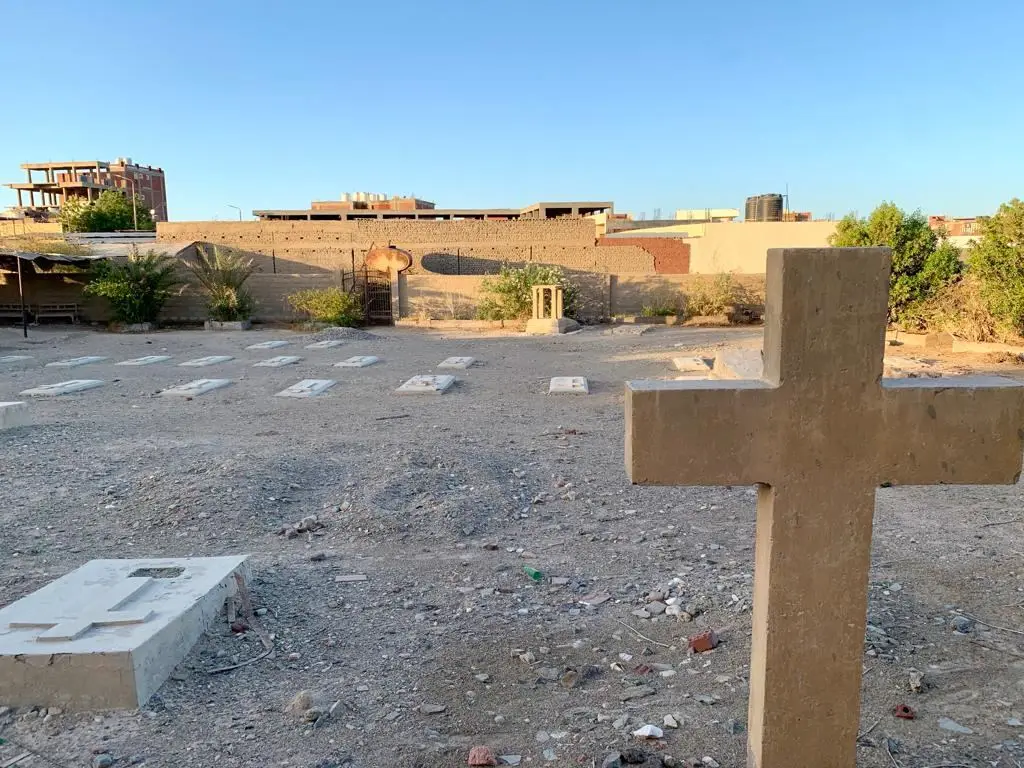
The most prominent survival from that period is the Italian cemetery, which holds the remains of 24 Italian managers and workers, and a child. A large marble plaque records their names and their dates of birth and death.
Wasfi Tamir, an El Quseir resident who follows the town's heritage, said the graves were built in a simple and distinctive way, from vertical and horizontal stone slabs pointed at the top, rather than the costlier traditional stone tombs. He said two Italian families later flew their relatives' remains home to Italy by private plane, and that the empty transport crates stood beside the graves for some time afterwards — a detail the town still remembers.
In 1926, during a visit to El Quseir to open the Gebel Duwi mine, King Fuad I ordered a wall built around the Italian cemetery to protect it as part of the town's history. Later widening of the main road cut into part of the cemetery's area, but it remains in place.
The report gives no visiting arrangements, opening times or access details for the cemetery, the Colony or the old port, and we have not confirmed any independently.